Tuesday, 5 March 2013

Election Day

It would be very hard in Nairobi not to know that we were having a major election. (And probably around the world too given what I’ve seen on BBC, Reuters and other websites.) Over the weekend, campaigning intensified with the two frontrunners holding large rallies in two of the major venues: Nyayo Stadium which is just down the hill from where I live and Uhuru Park, about a mile away. During the day, I’d encountered truck and bus loads of people wearing T-shirts and baseball caps in the colours of their respective parties, waving and throwing flags, blaring music, evidently headed to the rallies. And even a cavalcade of about 20-30 motorbikes, sounding their horns. It all had a very celebratory feel about it. Later on, I was able to watch the broadcast of the rallies, whilst getting a stereo effect from the one being held at Nyayo Stadium, the sounds drifting in through my open windows.

One television station showed the two rallies simultaneously, the
audio going from one to the other
By contrast, today everything was very quiet. Barely any traffic, other than police helicopters going overhead. The construction that has been going on for more than 5 months now, ceased completely. Quite a relief from the pounding! Supermarkets were closed. Nearly all the local TV stations were broadcasting one thing – the elections.
For Kenyan citizens registered to vote, it was a day of standing in long, long queues in the blazing sunshine awaiting their turn. Whilst there were a few flare-ups, the over-riding impression was of the resilience of Kenyans and their determination to exercise their right to vote. And many turned up. They’re reckoning over 70% turnout.
The process for voting itself seemed quite complicated. It’s a long time now since I voted in person in the UK (it’s been by proxy for 10 years now), but I just seem to remember having to put an X in one box. Here, they’ve been voting today for 6 different positions:-
1.       President. There are 8 candidates. The winning candidate must get more than 50% of the total votes cast, and at least 25% of the votes in half of the 47 counties. If there is no clear winner, a second round of voting will take place between the top two candidates on April 10th.
2.       Member of the National Assembly (ie MPs).
3.       County Assembly Ward Representative.
4.       Senator.
5.       County Women Representative.
6.       Governor.
Each has its own ballot paper, with the list of candidates, including their photographs. Each ballot paper is colour-coded, and then gets dropped into a box, with a lid of that same colour. Clever!
The voting procedure laid out in Sunday's paper
To guard against rigging of votes, the process for getting in to vote has been quite rigorous, checking people’s registration cards, their ID, and even their fingerprints. It’s no small wonder that the queues were as long as they were, some people waiting up to 5 or 6 hours to cast their vote. As they waited today, so now, we all wait to hear the outcome.
There have been many appeals for peaceful elections. This one from
the Office of the President

Friday, 1 March 2013

A Prayer for Kenya

I find it interesting that at the heart of the Kenyan National Anthem is a prayer for peace and unity. That seems very poignant at this time, as the Kenyan people go to the polling stations on Monday to choose a president, members of parliament, senators, county governors and members of the newly formed county assembly. Not so remarkable in itself. Yet this is  against the backdrop of the inter-ethnic post-election violence of 5 years ago, when more than 1,200 people were killed, and up to 600,000 were displaced from their homes (some of whom are still in IDP camps today).
 
(In Swahili)
Ee Mungu nguvu yetu
Ilete baraka kwetu
Haki iwe ngao na mlinzi
Natukae na undugu
Amani na uhuru
Raha tupate na ustawi.

Amkeni ndugu zetu
Tufanye sote bidii
Nasi tujitoe kwa nguvu
Nchi yetu ya Kenya
Tunayoipenda
Tuwe tayari kuilinda

Natujenge taifa letu
Ee, ndio wajibu wetu
Kenya istahili heshima
Tuungane mikono
Pamoja kazini
Kila siku tuwe na shukrani
 
(In English) 
O God of all creation
Bless this our land and nation
Justice be our shield and defender
May we dwell in unity
Peace and liberty
Plenty be found within our borders
 
Let one and all arise
With hearts both strong and true
Service be our earnest endeavour
And our Homeland of Kenya
Heritage of splendour
Firm may we stand to defend
 
Let all with one accord
In common bond united
Build this our nation together
And the glory of Kenya
The fruit of our labour
Fill every heart with thanksgiving
Amen and Amen!

Thursday, 28 February 2013

Contingency Planning

‘Contingency Planning’ is a phrase that is much in vogue around Nairobi at the moment. With the elections just 4 days away (March 4th), and the memories of what happened after the December 2007 elections rather too fresh in people’s minds, organisations and embassies have been issuing contingency plan recommendations. To give an idea of the sort of thing being talked about, here’s a sample of items to think about as listed by an advanced driving school in Nairobi, which sends out various security updates.
  • Do you have enough non-perishable food supplies in your pantry in case movement is restricted during that time?
  • Extra bottled water is essential. Have at least a 5-day supply per person in your pantry. Eleven litres per person per day will give you enough to drink, for limited cooking and personal hygiene.
  • Will you be able to cook if electricity is shut off for an extended period? Consider alternatives. Having a full gas cylinder plus a spare, as well as charcoal and firewood should also be on hand. Extra matches are a must!
  • What about lighting for your home if there are extended power cuts? Do you have candles? Batteries for torches? Solar lamps or other methods of lighting? If you have a generator, do you have sufficient fuel?
  • Can you charge your mobile phone if the power is off for extended periods?
  • If you or your staff, have pre-paid SIM cards, do you have spares available? What happens if phone service is cut off? Do you have alternative methods of communicating with loved ones?
  • Do you have a bag packed with essential items in case you have to evacuate your home in a hurry? Remember to include each member of your family and consider any special need requirements.
  • Do you have a list of emergency point-of-contact phone numbers both in your car and on your person?
  • Is your vehicle ready in case of an emergency evacuation? When is the last time it was serviced? Is it full of fuel?
  • Do you have enough cash? Is it enough to last a month? Divide your cash and put it in separate areas of your home, don't keep it all in one place.
  • What about all of your important documents? They should be stored in safety deposit boxes or other secure locations. Consider making scanned copies and emailing them to yourself in case you lose the originals. Important documents include passports, insurance policies, family records (marriage and birth certificates), land title deeds, bank cards, etc.
We’ve also spent quite a bit of time discussing this at work, both related to personal contingency plans, and for the organization itself. With an emergency phone chain in place, everyone can be contacted quickly (assuming phone lines are operating). We’ve been busy ensuring that absolutely everything is backed up, and that important documents are scanned. The office will be closed for 3 days (election day itself is a national holiday anyway) so that people can stay home and not be moving around the city, other than to vote. Come Thursday, we’ll see how the land lies as to whether business resumes as usual or not.
It really is a lot to think about, and in some ways, even thinking about this sort of thing can engender anxiety and fear, though we all hope that none of it will be needed. But it would be pretty bad not to have planned in this way, and then a crisis erupt. It reminds me of the contingency planning that took place before Y2K. It turned out then that the computers didn’t all crash as the clock struck midnight on the night of December 31st 1999. I’m hoping that this will prove to be as uneventful as that was, and that I’ll be just using up the additional food, water, batteries, candles, phone credit, toilet paper etc etc gradually over time, whilst still being able to shop for fresh produce.

Tuesday, 12 February 2013

Between a Buffalo and an Elephant

I love going into Kenya’s national parks. I enjoy being able to escape the city for the wide open spaces. And the variety of scenery: From the grassy plains of Nairobi National Park; to the barren beauty of Samburu with its mountain ranges, and the Ewaso Nyiro river, lined with doum palms, meandering its way through; the flat, bareness of Amboseli with its backdrop of the majestic Mt Kilimanjaro; the vastness of bushy Tsavo; and Nakuru Park, with the lake as its central point (though currently minus its pink fringe of flamingos, for which it’s famed)…..
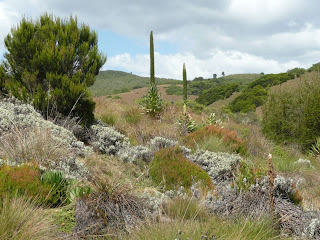
Giant lobelia dot the moorland landscape of the Aberdares National Park
A couple of weekends ago, I was in the Aberdares National Park with some friends. This again is so different. Densely forested in the lower sections, then rising to bamboo forest, and above that moorland reminiscent of Scotland, with cascading waterfalls, and the peaks of the mountains themselves still rising above. As well as the scenery of course, there’s the wildlife. And the emphasis here is on ‘wild’. One of the things that I was aware of from early on living here, was the lack of instruction as to what to do when you come face to face with something big. I’m not talking zebra, or even giraffe (though they’re clearly very tall), but rather the sort of beast that carries with it the kind of weight that when combined with a bit of force, could do serious damage to a vehicle – elephants, rhinos, buffalo, hippo…. Thus far, I’ve not had any close encounters, though I did once have a rhino seemingly give chase. Respect of course is the name of the game. And applying wisdom. If there’s a herd of elephants, I wouldn’t  go driving through the middle of them, especially if there are young.

On our trip to the Aberdares, we found ourselves between a rock and a hard place, or more accurately in this instance, between 3 very mean-looking buffalo, and a herd of 10 elephants, including young. And it was getting dark. And my petrol gauge was rather closer to empty than I’m generally comfortable with. We’d just come through a very muddy section of the ‘road’, the car slipping and sliding, and at times going sideways! The buffalo were standing separately at the side of the road, clearly aware of our passing by. Something in their eyes said that they weren’t feeling particularly amiable towards us. A little bit further on, a group of ellies were having a fine old time in some mud, just at the side of the road. We waited a respectable distance back, and in time, they moved on, again clearly aware of our presence, and also clearly in no hurry. However, their moving on was in a forwards direction, rather than sideways. They kept to the road! About 30-40 minutes later, we’d advanced maybe 100 metres, if that. One of the buffalo eventually wandered by, keeping a distance from us, and a rather larger distance from the elephants, going through the bush. We unfortunately couldn’t follow his example!
That's not a happy looking buffalo!
What to do?
  • Sit and wait? I was aware that once it was dark, we wouldn’t be able to see the elephants very well, and could find ourselves rather closer to them than we’d choose to be.
  • Race by? Given that some were actually on the rather narrow track, this really wasn’t an option. Elephants have a fairly wide girth!
  • Hoot at them? Probably not a good idea…..
  • Skirt around them? There really was nowhere to skirt, without risking getting stuck in mud and / or undergrowth.
The herd of elephants enjoying the mud
In the end, we chose to turn around (which took something like an 11-point turn on this narrow track, with ditches on either side), make our way back through the mud patch (involving a manouevre where we were caught in a rut at the edge of the road, the side of the car in contact with the grass verge (thankfully, there were no rocks there)), and take a track to another gate which we’d seen. We had no clue where it would take us, nor the state of the road en route, but it seemed the better option. And we did eventually make it, after 3 crossings of an incredibly rickety wooden bridge, an encounter with a closed electric fence, a closed barrier, and another 11-point turn, (not necessarily in that order!)……

Postering the town red (and blue, and green, and…..)

With just 3 weeks to go to the Presidential elections here in Kenya, it would be hard for anyone to miss the fact that there’s major campaigning going on. This evening, the first Presidential debate took place at one of the private schools, just outside the city. This was no doubt followed by many on television and radio, and for those who weren’t yet home, the effects were felt with traffic gridlock across the city.
However, what has impacted me has been the visual effect of the campaign, namely the plastering on pretty much every and any surface, of a plethora of posters. (A friend remarked yesterday, ‘Stand still for long enough, and you’ll get a poster on you’!) I first noticed these about 4 weeks ago, in the run up to the preliminaries, on my walk to the office. A nearby wall was festooned with multiple posters, all for the same individual. Particularly noticeable were all the backings to these posters which were strewn on the ground. Not exactly a good advertisement for this particular individual (or perhaps more precisely, for the political machinery behind him).
It has struck me that campaigning here would seem to be more about how many posters can be put up than anything else. Trees, walls, road signs, bridges, even drains – they’re all plastered with various individuals’ faces. And most of the time, it’s not sufficient to put up just one poster. Maximum coverage evidently applies here as well as to the media! Why just limit yourself to one poster on a wall for your candidate, when you could put up thirty?! It would appear that opposition tactics are sometimes to tear down the opponents’ posters, the life or durability of some seeming to be rather short….
Big billboards on the roads broadcast the major contenders with promises of jobs, more sports stadia, and a transformed country, amongst other things.
Yesterday, I was slightly delayed in my journey home by a campaign lorry in an outlying town. Music blared out, people on the lorry jigged around, and a crowd was gathered. Something evidently happened within the crowd that caused the lorry to suddenly move on, and then got into a fix as it attempted to turn around, backing into another road, consequently completely blocking the one that we were on. Cars, spray-painted with the name of this candidate, lined the route. It’s a while since I was in the UK during the run-up to a general election, but from what I remember, it seems to be rather a different ball game here.
Behind this family group is a flank of posters
A wall covered in posters (I counted 5 different ones)
Pillars supporting a bridge provide a useful surface
As does this tree and notice (I guess they won't be getting any phone calls at the moment!)
A new wall as part of the flyover being constructed on Langata Road - all of 2 different posters providing decoration here!
One of the main contending partnerships
A less messy way to advertise, and in Nairobi traffic, likely to catch the attention of plenty of people
Putting someone in the drain would have negative connotations elsewhere!
(Some of these photographs are courtesy of Jill Brace who was in the passenger seat, while I was driving.) 

Sunday, 13 January 2013

Driving Across Borders

The last border that I drove (or more accurately, was driven) across was from the U.S. to Canada. No forms needed to be filled out, no money paid, and no major questions about the content of the camper van that we were in, other than whether we had firewood (not firearms, firewood!). It took all of 2 minutes, well maybe 3 as I did get a stamp in my UK passport.
Crossing borders within Africa is somewhat different. I mostly cross borders in the air, but have done a few by road now. Last Tuesday was the first time that I’d driven myself from Kenya to Tanzania, and to be honest, I was a little anxious about this experience (or what it might be) beforehand. However, armed with instructions of the various offices to go to, plus a copy of my passport photo page, as advised by Nairobi friends who cross the border at Namanga quite frequently, I set off. The road down is beautiful, ie smooth! Amazing to have such a long stretch without needing to swerve repeatedly to avoid potholes. There were a few cows along the way crossing the road, that I needed to slow down for, and a few speed bumps in towns, but other than that, the driving part was smooth sailing. And the scenery stunning. Potholes did however appear once I got to Namanga town. I’d decided to get petrol there, except that there wasn’t any! Thankfully, not too big an issue, though it did turn out that the next petrol station (at least, that I noticed) was about 2 hours away.
First stop was before a barrier which I wasn’t sure if I was free to drive through or not. Here, I was assailed by guys trying to sell me vehicle insurance for Tanzania. I’d actually got this ahead of time, so didn’t need it. The price that they quoted when I asked, was less than I’d got in Nairobi, but then, a) was it a legitimate insurance company; and b) would the price have been the same had I not aready got the insurance…. I left them behind, and went into the first building, where I needed to write the particulars of my vehicle in a book. I’m still not overly sure why, as it turned out that this wasn’t the place to fill in the customs form. That came next. (Turned out on my return, that this was the police post.)
I drove through the barrier into what can only be described as a frontier town. Road lined with trucks, with multiple small businesses alongside it, including of course Customs and Immigration. The first of these was my next port of call. Here, I did get the customs form to fill in, which was then given an authorizing stamp. I was instructed to get a copy of it and of my passport (hence the small businesses along the way!). I enquired at one of the stalls, and was led down a back alley to a little office where an entrepreneur ran some sort of business, but on the side, did photocopies for people using his printer / copier. I’d been warned that I could be charged 100 times the usual rate for this (not exactly much choice, and where I’d usually go was a 2.5 hour drive back up the road!). So, I thought I’d done pretty well when he only charged me 10 times the usual rate!
At the Kenyan immigration hall, there were no Exit Declaration forms to fill out, which apparently didn’t make any difference. I’ve often wondered what happens to all these forms that dutifully get filled out every time I enter, and leave Kenya. Where do they all get filed? And if it doesn’t make any difference not having them, then why……? So, finger prints scanned and exit stamp in my passport, I drove the car onto the next bit, which is the Tanzanian side of things.
First stop was Immigration. They did have forms which needed filling in. Well, rather scrappy bits of paper really, asking for the usual details: Name; Passport number; Date and place of issue; Date and place of birth; Occupation; Address in Tanzania. After about 10 minutes, and $50 paid over for a visa, I was set to go.
Now to import my car into Tanzania. Another form to fill out relating to the car, with pretty much the same details that I’d stated on the Kenyan export form, a copy of which (plus copy of my passport) had to be handed over. (The skeptical side of me thinks that that requirement is just because they’re in cohoots with the guys doing the photocopying!).
And then, after about 40 minutes from start to finish, it was all done.
With my vehicle insurance (which no one had asked to see), export and import forms (stamped of course) in hand, I drove out of ‘No Man’s Land’ into Tanzania. I expected to be stopped at a barrier by someone to ensure that I had all the necessary stamps, visa and papers, but that didn’t happen. How easy would it be to bypass part of the system if you didn’t know what to do?! And what trouble could you get into later on if you did that?
And so, I entered Tanzania in my vehicle, the Kenyan plates clearly declaring to the world that I wasn’t from there, having only encountered helpful officals rather than the officious ones that I’d feared I might.
Looking back at the border area from the Tanzania side

Another vehicle on the road with me - evidently quite full!

Hazards on the road

Most of the jouney was through Maasailand

Coming back to the border on the way home
 

Thursday, 3 January 2013

Christmas and Plums!

My Christmas dinner this year, eaten outside on the sandy banks of the Athi River in Tsavo East National Park, Kenya, was very un-traditional. We did get to pull Christmas crackers, and wear the obligatory paper crowns, but had a delicious meal of tilapia, potatoes, vegetables and salad in place of the more usual roast turkey (that said, I’ve not had turkey on Christmas Day for 3 years now!). And pudding (or dessert, for American readers (we had a number of conversations on this subject amongst our group of 3 Brits, 1 American and 1 Canadian on safari)) was no different, with mango crumble in place of the traditional Christmas pudding. However, a few days later, I made Plum Pudding (as Christmas Pudding can be called) when some friends came round to my apartment for dinner. However, this really did have plums in it! Mid to late December is when local plums become available in Nairobi, street sellers selling them to occupants of vehicles as they sit in Nairobi traffic, in long thin bags, as well as being on sale in grocery stores. Unlike English plums, these are small, but equally tasty and sweet (when ripe, at least).  I’ll eat about 6 at a go! The first time I saw them, I actually mistook them for cherry tomatoes, and got quite a surprise! Plums aren’t exactly what I'd expected to find in a country on the Equator! However, they’ve become a fruit that I now associate with Christmas. I’ve done quite well for plums in the last few months. The house that was my base in Horsham during my furlough, had a plum tree in the back garden. We had plums coming out of our ears for a few weeks there in August! Sorbet, crumble, stewed, on their own, …… And now, here are plums again!
Plum pudding in the preparation stage